

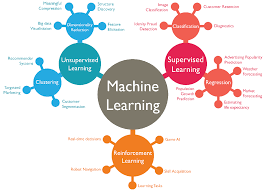
Machine Learning (ML) is a transformative technology that is reshaping industries and unlocking new possibilities across various domains. At its core, machine learning enables computers to learn from data and make predictions or decisions without being explicitly programmed. In this article, we’ll delve into the basics of machine learning, exploring its key concepts, types, and applications.
What is Machine Learning?
Machine learning is a subset of artificial intelligence (AI) that focuses on the development of algorithms and models that allow computers to learn from data. Instead of relying on explicit programming, machine learning systems use statistical techniques to enable computers to improve their performance on a specific task over time.
Key Concepts
1. Data
Data is the fuel that powers machine learning. It can be any form of information, such as text, images, numerical values, or even sensor data. The quality and quantity of data greatly influence the performance of machine learning models.
2. Labels and Features
In supervised learning, a subset of machine learning, the algorithm is trained on a labeled dataset. Labels are the desired outputs or outcomes, while features are the input variables. The model learns to map features to labels by identifying patterns and relationships in the data.
3. Algorithms
Algorithms are the mathematical models or rules that machine learning systems use to make predictions or decisions. There are various types of machine learning algorithms, including regression, classification, clustering, and reinforcement learning.
4. Training and Testing
During the training phase, the machine learning model learns from the labeled dataset. After training, the model’s performance is evaluated on a separate, unseen dataset called the testing dataset. This helps assess the model’s ability to generalize to new, unseen data.
Types of Machine Learning
1. Supervised Learning
In supervised learning, the algorithm is trained on a labeled dataset, and it learns to make predictions or decisions based on input features.
2. Unsupervised Learning
Unsupervised learning involves training models on unlabeled data. The algorithm discovers patterns, relationships, or structures within the data without predefined labels.
3. Semi-Supervised Learning
This type of learning combines elements of both supervised and unsupervised learning. The model is trained on a dataset that contains both labeled and unlabeled data.
4. Reinforcement Learning
Reinforcement learning is inspired by behavioral psychology. The algorithm learns by interacting with an environment and receiving feedback in the form of rewards or penalties.
Applications of Machine Learning
1. Image and Speech Recognition
Machine learning powers advanced image and speech recognition systems, enabling applications like facial recognition, object detection, and voice assistants.
2. Natural Language Processing (NLP)
NLP focuses on the interaction between computers and humans through natural language. Applications include chatbots, language translation, and sentiment analysis.
3. Predictive Analytics
Machine learning is widely used for predicting future outcomes, such as stock prices, customer behavior, and disease diagnosis.
4. Autonomous Vehicles
In the automotive industry, machine learning plays a crucial role in developing self-driving cars. These vehicles use ML algorithms to perceive the environment and make real-time decisions.
Challenges and Considerations
While machine learning holds great promise, there are challenges to overcome. These include data privacy concerns, the need for large and diverse datasets, and the interpretability of complex models.
Understanding the basics of machine learning is a stepping stone to exploring its vast applications and potential. As technology continues to advance, machine learning will undoubtedly play an increasingly integral role in shaping the future across diverse industries. Whether you’re a newcomer or a seasoned professional, embracing the fundamentals of machine learning opens the door to a world of innovation and possibilities.