
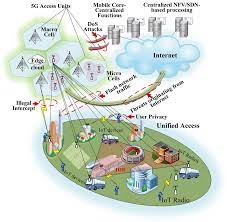
In the ever-evolving landscape of technology, the advent of 5G has emerged as a transformative force, promising a new era of connectivity and innovation. The fifth generation of wireless technology, aptly named 5G, is not merely an incremental upgrade but a leap into the future, poised to revolutionize the IT landscape. This blog post delves into the profound impact of 5G technology on various facets of the IT industry.
- Blazing Fast Speeds:
One of the most significant advantages of 5G is its unprecedented speed. With data transfer rates expected to be up to 100 times faster than 4G, users can experience almost instantaneous downloads and uploads. This boost in speed will not only enhance the overall user experience but also open new possibilities for data-intensive applications, such as augmented reality (AR), virtual reality (VR), and high-definition video streaming.
- Low Latency:
5G technology is set to drastically reduce latency, the delay between sending and receiving data. With latency expected to be as low as 1 millisecond, compared to the 30-50 milliseconds of 4G, real-time applications will become more responsive. This is a game-changer for industries like healthcare, where remote surgeries and telemedicine can be performed with unprecedented precision.
- Internet of Things (IoT) Revolution:
The Internet of Things is poised to reach new heights with 5G. The increased capacity and low latency will support a massive number of connected devices simultaneously. This will be instrumental in powering smart cities, autonomous vehicles, and industrial automation, where seamless communication between devices is crucial.
- Edge Computing Advancements:
5G will drive the adoption of edge computing, where data processing occurs closer to the source of the data. This decentralization of computing power reduces latency and enhances the efficiency of applications that require real-time processing. Edge computing, combined with 5G, will enable quicker decision-making in critical scenarios, benefiting industries like finance, logistics, and manufacturing.
- Business Transformation:
The business landscape will undergo a significant transformation with the widespread adoption of 5G. Enhanced connectivity will foster remote work capabilities, making telecommuting more efficient and accessible. Moreover, businesses can leverage 5G to optimize their operations, utilizing technologies like robotics and artificial intelligence for improved productivity and cost-effectiveness.
- Challenges and Security Concerns:
While 5G promises immense benefits, its implementation is not without challenges. The deployment of a dense network of small cells and infrastructure upgrades requires substantial investment. Additionally, concerns regarding data privacy and security have surfaced, prompting the need for robust cybersecurity measures to safeguard the increased flow of sensitive information.
Conclusion:
As 5G technology unfolds, its impact on the IT landscape is undeniable. From unleashing unparalleled speeds and low latency to catalyzing advancements in IoT, edge computing, and business operations, 5G is set to redefine the way we interact with technology. While challenges exist, the potential for innovation and positive transformation is immense. Embracing the 5G revolution is not just a technological upgrade; it’s an invitation to a future where connectivity knows no bounds, and possibilities are limitless.